A Boston University student gets real about the consequences of taking shortcuts with AI.
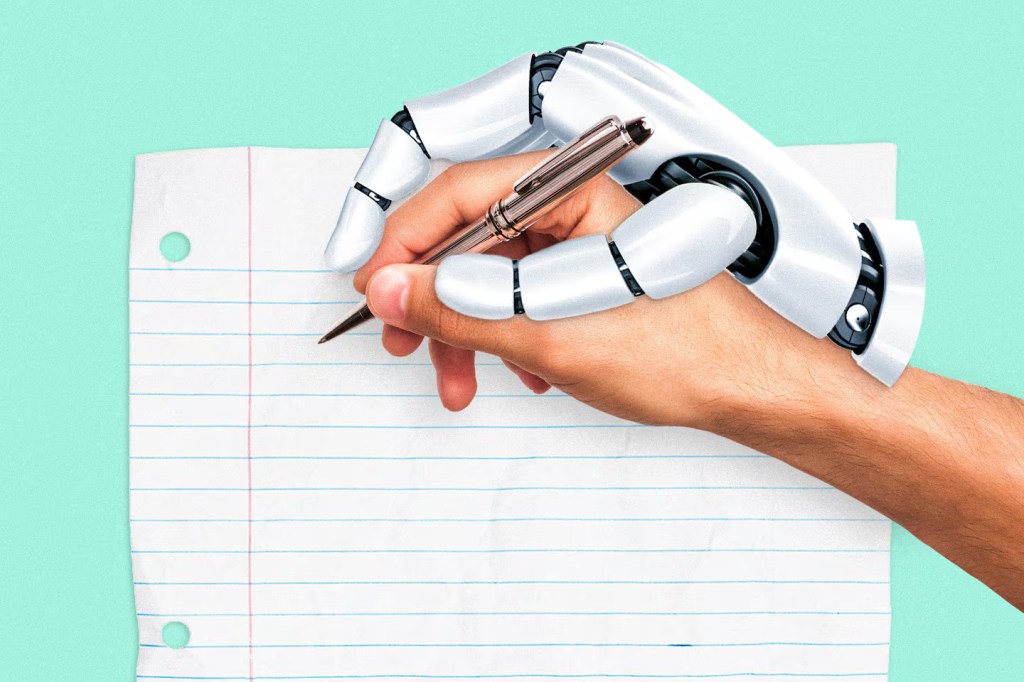
Looking for workarounds in required writing courses is nothing new for college students. Those trying to avoid writing essays and reports could always buy them. It was expensive and risky: Would the purchased paper be any good? You might spend $70 or more — only to get a C+. Or maybe it would be so good that the teacher would suss it out. But it worked well enough for some.
Now, thanks to AI, a similar shortcut is fast, free, and far more reliable. What used to be a gamble has become routine. As a student at Boston University since 2021, I’ve seen this shift play out across multiple courses and departments, where students speak among themselves about using generative AI for writing assignments.
One BU student, who wished to remain anonymous, says she used AI for writing in general education classes, which she didn’t enjoy as much as the assignments for her major. “I probably would have learned a lot more doing it myself, which is something I kind of regret,” she says.
In writing courses, where original work is central to the class, AI is often explicitly banned or tightly restricted. But in practice, those rules are unevenly enforced. Students use it anyway, and professors are left to interpret what crosses the line and what does not. Papers that once took hours are now seen by many students as manageable, even unchallenging. An easy “A” really can be within reach.
How does it happen? In most cases, students are not simply pasting in prompts and turning in AI-generated essays churned out in seconds as their own work. They use AI in smaller ways that are harder to define and even harder to detect. It’s easy to cue ChatGPT, Gemini, or Claude to rephrase sentences, smooth out structure, or tell it to “write in my writing style.”
More than half of US college students frequently use AI to edit or improve their writing, according to Lumina Foundation-Gallup research findings released April 2.
Even when instructors suspect AI use beyond grammar and spelling, proving it is another matter. “Research shows individuals are not very good at distinguishing between AI-generated and non-AI-generated texts,” says Sarah Madsen Hardy, director of BU’s College of Arts and Sciences writing program, especially when the writing is only partially assisted.
The same challenge plays out in Michael Dowding’s classes. There’s no “foolproof” way to detect AI, says Dowding, a master lecturer in BU’s College of Communication, and director of its writing program. When there’s reason to suspect a submitted assignment has been manipulated, he says, “We’re supposed to keep moving forward as if that was authentic writing” because there is no conclusive evidence.
Instructors can add statements to their syllabi about generative AI being prohibited, says Elena Kallestinova, director of MIT’s Writing and Communication Center. But generally, “Instructors do not police. We don’t have any control. We don’t have any leverage. There’s no way of me enforcing that.” Instead, instructors focus on pointing out areas for “improvement” when they suspect a student has crossed the line with generative AI use.
Dowding has adapted his courses by asking students to complete writing assignments in person on their laptops, under his supervision, to establish what he calls an “assurance of authenticity.” Those early samples become a basis for comparison should later work differ sharply in tone or quality. While this approach can provide a baseline, it doesn’t offer a complete solution. It’s time-consuming, difficult to scale across multiple assignments, and still relies on judgment by a professional rather than objective proof.
Complicating the situation further, widely used AI detection tools can produce false positive rates exceeding 60 percent in some cases, according to a Stanford University study of college-level essays, while detection rates can drop as low as 13 percent when the text is slightly modified. Rules exist, but the tools to enforce them often do not.
Added to this challenging mix: AI is fast becoming a standard tool in many workplaces, where employers expect new hires to understand AI’s applications in their industry — and use it.
That spells trouble in the learning phase. “Employers are focused on output and metrics, and they’re not worried about developing your intellect,” Dowding says. “In many academic settings, generative AI can be a wonderful tool, but not in teaching somebody how to write.”
This tension leaves students caught between conflicting expectations. As more people use AI for writing, the pressure shifts. What once felt like cutting corners can start to feel like keeping up. In practice, students are left to decide themselves whether to use AI. “It’s going to take a very disciplined young person to say, ‘I’m not going to use that,’” Dowding says.
For now, writing courses are still built around the same goal: teaching students how to think through writing. “It’s a cognitive laziness that is developed if we rely too much on AI,” MIT’s Kallestinova says. “[Writing] is a long, complicated process, and every single step is cognitive where we engage our brain.”
For Madsen Hardy, the writing program director, “The human element is more important than ever” now — it’s the “individual perspective or take on things, or the creativity that people bring that becomes more important in the writing process.”
As AI becomes more embedded in how students work, the gap between what writing courses are meant to teach and how students complete them is no longer theoretical — and it’s reshaping those courses in ways institutions are still figuring out how to respond to.
“Writing is thinking,” Dowding says, “and when you outsource the writing, you’re outsourcing the thinking.”
It’s a cost some students are willing to pay. Not all at once, but gradually — line by line, draft by draft — until writing without AI no longer feels natural.
Sangmin Song is a senior in journalism at Boston University. Send comments to magazine@globe.com.
The article was originally published here.


Leave a Reply